

Most veterinary practice owners evaluate their practice management software (PIMS) by looking at one number: the monthly subscription fee. But that number rarely tells the full story.
The real cost of your PIMS shows up in places you might not be measuring, such as the hours your staff spend on documentation each day, the third-party tools you pay for because your software can't do it all, and the revenue you leave on the table when reminders fall through the cracks or appointments get double-booked.
This post walks you through a simple framework for calculating the true cost of your practice management software, so you can make an informed decision, whether you're evaluating your current system or considering a change.
The four cost categories to evaluate
1. Direct software costs
This is the most visible category, but even here, there's more than meets the eye. Start with your base subscription, then add:
- Add-on modules: Many platforms charge separately for features like online booking, two-way texting, reporting, or wellness plan management.
- Per-location fees: If you run multiple clinics, per-location pricing can scale quickly.
- Per-user fees: Some systems charge by the seat, meaning your costs grow as your team does.
- Implementation and training costs: One-time setup fees are often quoted separately from the ongoing subscription.
What to calculate: Add up every line item on your PIMS invoice, not just the base fee. Then multiply any per-location or per-user costs by your actual headcount and clinic count.
2. Third-party tool costs
A PIMS that doesn't do everything forces you to bolt on external tools to fill the gaps. These costs add up quickly and are easy to miss because they show up on different invoices.
Common add-ons practices pay for separately include:
- Online booking platforms
- Client communication and reminder services
- Two-way SMS messaging tools
- Controlled substance logging software
- Reporting and analytics dashboards
- Treatment sheet or whiteboard tools
What catches many practices off guard is how quickly the add-ons compound. Beechwold Veterinary Hospital, a 50-year-old general practice, found that their previous PIMS required a separate third-party platform just to handle appointment reminders, a line item that cost them $200+ per month on top of their base subscription. When they switched to Vetspire, that cost disappeared entirely because the functionality was already built in.
What to calculate: List every software subscription your clinic pays for that exists because your PIMS can't handle it. Total those costs per location per month.
3. Staff time costs
This is the category that most practices significantly underestimate, and it's often the biggest one.
Documentation alone can consume an enormous portion of a clinician's day. If your PIMS requires manual data entry, switching between screens, or re-typing information across multiple systems, those minutes add up across every appointment, every day.
One veterinary dermatologist at Dermatology for Animals put it plainly: "I used to be here until 6:30 or 7." On her first day using Vetspire's AI Scribe, she was done with her charts at 5:11pm. Across her team, that translated to 90 minutes saved per clinician per day, and the elimination of all overtime related to charting and record-keeping. At Beechwold, the number was 15 minutes saved per appointment, which across a full day of appointments adds up to several hours of recovered clinical capacity.
Here's a simple way to estimate:
Step 1: Ask your DVMs and techs how many minutes they spend on documentation per appointment (notes, treatment sheets, invoicing, client communication follow-up).
Step 2: Multiply by the number of appointments per day, then by the number of clinical staff.
Step 3: Multiply by your average hourly cost for clinical staff.
Example:
- 8 minutes of admin per appointment
- 20 appointments per day
- 4 DVMs/techs
- $45/hour average clinical wage
That's 8 × 20 × 4 = 640 minutes per day, or about 10.6 hours of clinical time spent on documentation daily, at a cost of roughly $480/day across your team.
Platforms with AI scribing and automated workflows can meaningfully cut this number. Even recovering 30 minutes per clinician per day adds up to significant savings in labor cost and clinician capacity over a year.
4. Opportunity costs
This is the hardest category to quantify, but often the most impactful.
Missed reminders mean pets that age out of wellness visits or vaccinations. Scheduling gaps leave unfilled appointment slots or cause double-bookings. And clunky software contributes to clinician frustration and burnout, one of the most expensive hidden costs in veterinary medicine, given what it costs to replace a DVM or experienced tech.
There's also the client experience angle. An owner of multiple general practice clinics who switched to Vetspire found that 20–30% of their clients now book appointments online, directly filling last-minute scheduling gaps that previously went unfilled. That's a revenue recovery channel that didn't exist with their previous system.
Opportunity cost is the revenue your practice isn't generating because of software limitations. Some examples:
- Missed reminders: Pets that age out of wellness visits or vaccinations because automated reminders weren't triggered.
- Scheduling gaps: Inefficient scheduling tools that leave unfilled appointment slots or cause double-bookings.
- Staff turnover: Clunky software contributes to clinician frustration and burnout, which drives turnover — and replacing a DVM or experienced tech is expensive.
- Client attrition: A poor communication experience (no easy online booking, slow responses, missed follow-ups) can drive clients to other practices.
What to calculate: Even conservative estimates here are useful. If your practice sees 20 patients per day at an average ticket of $180, a 5% reduction in no-shows or missed appointments from better reminders is worth $180/day, or roughly $45,000 per year.
Putting it all together: A simple cost audit
Here's a one-page framework you can complete in under an hour:
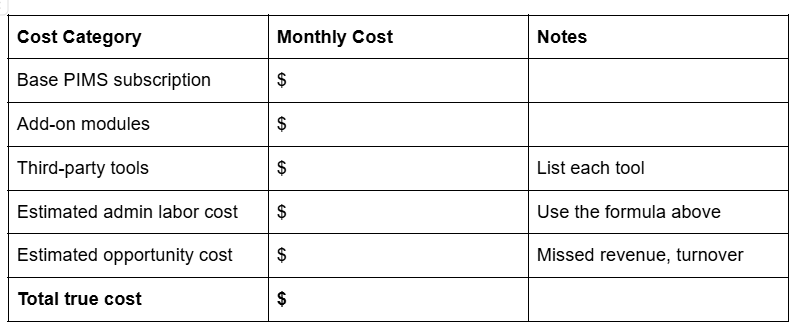
Once you've completed this audit, compare it against what an all-in-one, modern platform would cost, including everything bundled in.
What to look for in a more cost-effective system
When evaluating alternatives, ask vendors these questions:
- What's included in the base price? Make sure scheduling, reminders, messaging, and reporting are bundled, not sold as add-ons.
- Is it cloud-based? Cloud platforms eliminate the need for on-premise servers and IT maintenance, which carry real hidden costs.
- Does it include AI tools? AI scribing and automated documentation can recover hours of clinical time per week.
- How fast is onboarding? A long implementation drags out the period where you're paying for two systems simultaneously.
- What does multi-location pricing look like? For growing practices, per-location fees can erode the value of switching quickly.
What Vetspire customers actually report
These aren't projections — they're outcomes reported by practices already on the platform:
Ready to see what the numbers look like for your practice? Schedule a demo and we'll walk through it together.
The bottom line
Your PIMS is one of the most consequential financial decisions in your practice. A system that appears affordable on paper may be quietly costing you in staff time, third-party subscriptions, and missed revenue every single month.
The goal of this audit isn't to arrive at any particular answer — it's to give you an honest picture of what your current software is actually costing you, so you can weigh it against what's possible with a modern alternative.
If you'd like to see how Vetspire stacks up against your current costs, schedule a demo and we'll walk through it together.